
Garage Door Repair · St. Louis Park
Garage Door Repair in St. Louis Park, MN
Garage door repair for St. Louis Park's 24,126 households, mostly built around 1965 - older torsion hardware and worn rollers are the common calls here.
How It Shows Up
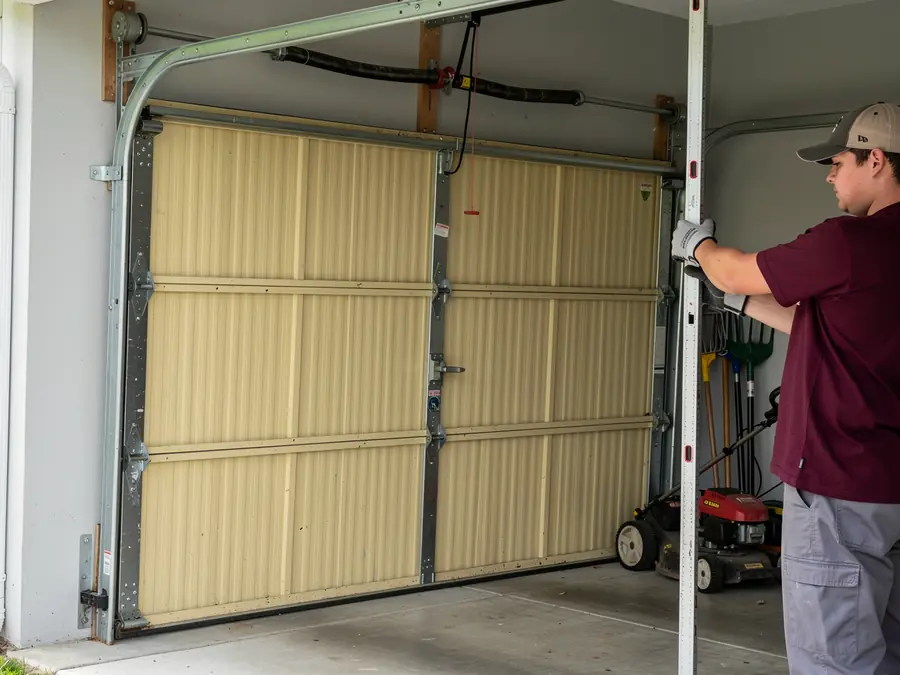
St. Louis Park holds about 24,126 households, a tighter market than the wider area Blaine Garage Door Pros covers, where the broader service area runs closer to 258,628 households. That smaller scale matters less for the work itself than the age of the houses sitting in it. The median home here was built around 1965, which puts a good share of the city's garage doors well ahead of the service area's overall median build year of 1980. That fifteen-year gap shows up as real wear: steel sectional doors from that era often ride on tracks that have been re-hung once or twice, and the hardware underneath doesn't always match what came with the house.
What we see most from this pocket of the metro is springs that have outlived their coil count and openers that were swapped out sometime in the 90s but never paired with a working safety sensor. None of that is unique to one street - it's a function of a city whose housing stock skews older than its neighbors. A door that's run quietly for 50-plus years on original parts is not unusual here, and when it finally lets go, it tends to let go all at once rather than giving warning.
What It Costs
We don't have a published price list to hand you here, and we're not going to invent one. What we can say is that the age of a typical St. Louis Park door changes the math on repair versus replacement. A torsion spring job on a door from the 1965-era wave is usually straightforward - the spring sizes from that period are common stock. Where it gets more expensive is when the track or the drum has been bent from years of use, because that's not a part swap, that's a rebuild of the whole side of the door.
Income in this part of the metro runs around $100,250 for a median household (close to the service area's $100,179 overall, per F7), which tells us less about pricing than about what gets fixed versus replaced. Homeowners here tend to ask for the repair first and only move to full replacement when the door itself - not just the hardware - has failed. That's a reasonable order of operations, and we'll tell you honestly when a repair isn't worth doing.
Booking a Visit
Blaine Garage Door Pros runs this call from Blaine, about 17 miles out. We don't have a branch or depot in St. Louis Park, and we're not going to claim one. What that distance means practically is that we schedule the drive rather than treat it as a walk-up service area, so a call booked earlier in the day gives us more room to work your job into the route.
When you call, the two things that speed up the visit are the same two things that matter on any older door: what the door is doing (won't open, won't close, makes noise, opener runs but door doesn't move) and roughly how old the door and opener are. If you know the house was built in the mid-1960s and the door looks original, say so - it tells us what size spring and what track profile to bring instead of guessing on-site.
What Can Go Wrong
The service area sits in a cold climate band with severe winter conditions, and that cold is hard on steel springs and nylon rollers regardless of the house's age - contraction stresses metal that's already fatigued. On a door built around 1965, that stress lands on hardware that's had sixty winters to wear down, not twenty. Broken torsion springs, cables that have frayed at the drum, and rollers that have worn their track groove wide are the three calls we see most from houses this age.
Openers are the other weak point. A lot of these homes have had the opener replaced once already, sometime in the 80s or 90s, but the original door and track were kept. That mismatch - a newer opener pulling an older, heavier door - is often what finally snaps a spring that had years of life left in it. We can usually tell which failure caused which on-site, but a door that's been limping along on a bad roller for months can take out the opener's gears along with it.
How Long It Takes
Most spring and roller repairs on a door this age are a single visit - the parts are common and the work itself is mechanical, not something that needs a special order. Where it slows down is a bent track or a damaged panel, because those sometimes need a measurement visit before the right part gets ordered, especially on an original 1965-era door where the panel profile may not match what's on the shelf today.
We're straightforward about that lead time when it applies: if your door needs a panel that isn't a stock size, we'll tell you at the first visit rather than let you assume it's a same-day fix. For everything else - springs, cables, rollers, sensor alignment - the drive from Blaine is the bigger variable than the repair itself.
FAQ
Questions about this
Do you have a location in St. Louis Park?
No. Blaine Garage Door Pros runs out of Blaine, about 17 miles away, and drives out for St. Louis Park calls. We don't have a depot or branch here, and we won't claim one. The distance just means we schedule the visit into a route rather than treat it as a walk-up stop.
Why do older St. Louis Park doors break more often?
The median home here was built around 1965, roughly fifteen years ahead of the broader service area's median build year of 1980. Hardware from that era has simply had more winters to fatigue, and springs or rollers that have run for decades tend to fail without much warning once they finally go.
Is it worth repairing an original door from the 1960s?
Often yes, if the track and panels are still straight - spring and roller parts from that era are common stock. If the track is bent or a panel's profile doesn't match what's sold today, replacement can end up cheaper than chasing custom parts, and we'll say so plainly before we start.
Tell us what your door is doing.
We serve Blaine, MN and nearby communities. Every job starts with a diagnosis, so you know what failed before any work begins.